
When I signed up for Mindgrasp’s free trial, I told myself what everyone tells themselves: I’ll cancel before it charges me if I don’t find the product helpful. I didn’t. The trial flipped to paid overnight on March 1, 2026, and I cancelled the very next day, less than 24 hours later.
They want $71.88.
Not a prorated amount. Not a partial refund. The full billing cycle, for a service I barely used, that I tried to exit the morning after it started. And when I emailed them about it on March 31st? I didn’t get a response until April 22nd.
That’s when I started Googling. Turns out, I’m not alone.
TL;DR:
- Mindgrasp charges immediately when your free trial ends
- There is no grace period, even if you cancel the next day
- Support responses can take weeks
- If charged, dispute it with your bank immediately
What Mindgrasp’s Cancellation Process Actually Looks Like
On paper, cancelling your Mindgrasp subscription is straightforward:
- Log in and go to Account Settings → Billing
- Click Cancel Subscription and confirm
- Save the confirmation email and screenshot every screen
If you subscribed through Apple, you cancel through Settings → your name → Subscriptions → Mindgrasp. Google Play works similarly through the Play Store’s subscription manager. The steps aren’t hidden. That’s not the problem.
The problem is the window.
The Trial Trap Nobody Warns You About
Here’s what I wish someone had told me before I signed up: Mindgrasp’s billing cycle starts the moment your trial expires — not when you notice it, not when you check your email the next morning. The second midnight passes, you owe a full cycle.
Mindgrasp refund policy
Mindgrasp’s official policy explicitly says: no refunds once a billing cycle has started, unless you cancelled before the billing date. “Before” doesn’t mean within 24 hours. It doesn’t mean the same calendar day. It means before the clock strikes midnight on your trial end date.
I cancelled the next morning. In their eyes, I was already a full year in.
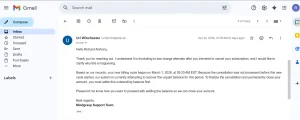
The response I eventually got didn’t dispute my cancellation. It told me the billing cycle had already begun on March 1st, that the system was attempting to recover the unpaid balance, and that the account couldn’t be fully closed until I settled it. The cancellation, in other words, was being held hostage to a charge I never agreed to pay.
It’s Not Just Me
A quick look at Mindgrasp’s Trustpilot page tells a consistent story. One reviewer cancelled in March 2024, received a confirmation email, and then found charges resuming in January 2026, nearly two years later, with no response to months of follow-up emails. Others describe the cancellation flow as deliberately multi-step. Several use the word “trap.”
The TikTok comments are less diplomatic.
What’s striking isn’t that a billing dispute exists — those happen everywhere. It’s the pattern: slow support responses, a refund policy with no grace period, and a stance that treats a next-day cancellation the same as never cancelling at all.
How to Actually Protect Yourself
If you’re still in your trial, do this now:
Set a calendar alarm for 2–3 days before your trial ends. Not the day of — days before. Treat the trial expiry like a flight. Missing it by hours costs you the full fare.
When you cancel:
- Screenshot every screen in the cancellation flow
- Save the confirmation email immediately
- Check your bank statement the following month to confirm the charge didn’t go through anyway
If you’re already in my situation — charged after cancelling or within hours of a trial conversion — here’s the honest path forward:
- Email [email protected] with your cancellation confirmation and any screenshots you have
- Don’t wait for a response before acting — their reply time can stretch to three weeks or more
- Contact your bank or credit card issuer and dispute the charge. A documented same-day or next-day cancellation is strong evidence
- File a complaint with the FTC at reportfraud.ftc.gov if charges continue or go unresolved
The Bottom Line
Mindgrasp isn’t necessarily unique in having aggressive billing practices. But the combination of a no-grace-period trial, a multi-step cancellation flow, slow customer support, and a policy that requires you to pay a disputed balance before your account can even be closed — that’s a stack of friction that falls entirely on the user.
If you’re searching “how to cancel Mindgrasp,” you already know something feels off. Trust that instinct. Document everything. And if you haven’t signed up yet, go in with your eyes open, alarm set, and a finger ready to cancel before that trial clock runs out. If a free trial requires this much vigilance to avoid being charged, it’s not really free.
Have you had a similar experience with Mindgrasp? The comment section is open.

Richard Anthony is a veteran tech writer focused on the practical side of AI. He reviews software, solves technical problems, and writes guides to help you navigate the fast-moving world of artificial intelligence. His goal is to provide clear, actionable advice without the jargon.
